One aspect of emotional intelligence is the ability to manage our emotions. Let’s face it. A lot of people get on our nerves and there are a lot of things that trigger us. Whether it stems from childhood trauma, work hurt, failed romantic relationships or some other painful experience, at some point we can decide to take our power back. We just have to accept that the only thing we can control is our response to people. Learning to utilize that space between a trigger and our response is golden.
Fortunately, this is a skill that can be mastered. It’s empowering to know that we can control our emotions. They don’t have to control us. Centering is finding that place where you have more degrees of freedom, more options, you’re more open. When you’re off balance it’s reflected in your life. Whereas, when you find your center, life can’t knock you off balance so easily. It might be helpful to consider that the center of the body is stillness. While the center of language is silence and center of the mind is peace and acceptance.
It takes practice but finding a way to calm your nerves is why many coaches and counselors focus on helping people find ways to center themselves. The quickest way to get a handle on our emotions is through deep breathing. Getting oxygen to our brain helps us to focus and calm down. And it only takes a few seconds. Other options may take more time and intention. For example, many people practice meditation to center their minds and others proYoga as a technique for centering the soul and finding peace.
The key is remembering that we can master our emotions and not let other people knock us off center. This is especially important when building and sustaining personal relationships. Mastering our emotions is not just about finding peace within, it’s also about keeping the peace and making peace with others. It’s about learning to give grace and forgiveness. We can learn how to let things go and not let things bother us to the point of dysfunction. As a tip, in that pause between an action and your reaction ask yourself “is this worth troubling myself?” and “will the relationship be better off, if I react or let it go?” Sometimes the trigger is more about us healing than the person who triggered us.
Ephesians 5 reminds us that when God is at the center of our relationships and his Spirit fills our hearts and minds, we are more than one and two. Our love grows and spreads exponentially. And we know that love covers a multitude of wrongs.
Tomorrow’s followers will require a new type of leadership. The world is changing fast, and the workplace is adapting out of necessity. Business environments are multicultural, and people are transient across international borders more than ever. Issues of worker migration, global trade, cybersecurity, new technology, and, yes, even identity issues require leaders who not only value diversity but can leverage it for better results. I learned the concept of “identity” from idealistic millennials, for whom being authentic is a core value. They want the freedom to bring their whole selves to work and do not feel the need to assimilate. Recognizing the new mindset, Corporations are changing to attract this ambitious, talented, and worldlier generation. This new generation of workers has access to more information at their fingertips and a better appreciation for global issues than previous generations, yet they still need role models. They must be nurtured and inspired. They must be challenged and given boundaries. They need leaders with the courage and confidence to solve problems we have not yet conceived.
A rose is a rose, but not all leaders are made equally. Those who identify as leaders may share similar characteristics, but they are not all the same. Certainly, some aspects of leadership are innate. Some people have a natural ability to inspire multitudes to act or believe a certain way. Some leadership behaviors can be taught, such as how to plan, how to manage a project, and how to communicate a way forward that motivates others to act. In fact, the topic of leadership and what it means has been extensively studied. However, there is no singular definition or even theory that researchers agree on. Some leaders are visionaries who help others see a better tomorrow with clarity and color. Some are excellent strategists who know how to develop a plan of action and pull the resources together for people to get it done. Others know how to inspire and motivate people to achieve a vision even if it is not their own. Leaders do not do things alone; they work to ensure that objectives are achieved effectively, efficiently, and without harm to stakeholders to achieve a better future. I believe that leadership is what you do and who you are rather than your title, so I have embraced the label of a leader as describing someone who influences others by words or deeds to act or think differently.
As another generation of young professionals join corporations with ambitions to make their mark, it is important that we re-evaluate the type of leadership required for the 21st century. These new followers need a new type of leader to inspire trust, creativity, and motivation. These leaders must have what Daniel Goldman calls emotional intelligence, which includes astute self-awareness, self-regulation and motivation, empathy, and social skills or relationship management. Self-awareness is critical to recognizing conscious and unconscious bias, which is all too common among individuals who have little exposure to different cultures. Self-regulation and motivation allow leaders to build credibility and demonstrate clarity on required outcomes. The ability to manage emotions comes with maturity and experience in dealing with challenging people and situations. Finally, trust is the foundation for developing productive relationships that can empower others and unleash creativity.
Today’s youth are motivated to excel by leaders that they believe care about them as people. They are not easily impressed by gray hair and war stories. This doesn’t mean that young people don’t value wisdom, knowledge, and experience, but they want leaders who inspire them. They will not care what you know until they know that you care about them as humans. Women, particularly mothers, understand how to handle people with care and consideration of their individual needs and motivations. We have learned, through parenting, how to value differences in our children. This helps us to be more empathetic, appreciate diversity, and value each individual’s contribution. We lead from the heart as well as the head.
Large multinational companies are having to change the way they do business in the face of a more transient, tech-savvy workforce and increased competition for global talent. Just a decade ago, companies were moving work across the globe to lower personnel costs, but now the talent is moving across borders to find higher-paying jobs. It is increasingly hard to find a company with a homogeneous workforce, so learning to lead a multicultural team is a critical competency required for future leaders. There are significant efforts to improve the skills and abilities of today’s corporate leaders in the face of this changing environment. However, what is forgotten or minimized is the impact of cultural differences and the skill levels of workers on the leader’s ability to influence productivity. Leaders must be able to recognize that different cultures are motivated by different factors. Maslow’s hierarchy of needs is a place to start for insight into what drives behavior, but it is easy to simply focus on developing authentic relationships. This means getting to know people, individuals that you need to influence, and what is important to them.
I believe that leadership is a calling and a gift, but it can be wasted without opportunity and nurturing. Like other natural abilities such as intelligence, self-confidence, determination, integrity, and social skills, leadership skills are honed over time and heavily influenced by nature and nurture. As leaders, we are the sum of our experiences and the teachings of others. Natural leadership abilities, when combined with good management skills, can make anyone an extraordinary leader in business, given the right opportunities. It simply takes confidence to take on leadership roles and to get out of our comfort zones to stretch ourselves. We must not only take advantage of opportunities to learn and grow with challenging assignments, but we must also seek them out. Our productivity is enhanced as we focus on our strengths, delegate activities in our weak areas, and continue to develop as leaders with each new experience. Without the opportunity to shine, a person with natural leadership ability will just be an interesting person to know.
Women and Minorities Lead Differently
I believe that unrealized potential is a waste of God-given talent. Unfortunately, women and minorities continue to face barriers to reaching senior positions within corporations. Despite decades of focused development for both women and minorities with some visible success, there are still gender and cultural biases, prejudice, and other barriers that affect progress. Dealing with gender bias, ethnocentrism, prejudice, and cultural bias is something that affects aspiring leaders at every level in an organization. In Cracking the Corporate Code: The Revealing Success Stories of 32 African-American Executives, the authors note the reality that minorities and women leaders tend to have a slower career progression initially, with more testing and requirements to prove that they have leadership potential than others. This has the effect of them having significant functional expertise when and if they achieve a position in the C-suite. Because they often do not get to senior corporate positions, these limitations are igniting a surge in entrepreneurship among women and minorities in the U.S. Business ownership puts them more in control over their own destiny and creates their own leadership development opportunities.
By capitalizing on what makes them unique, female and minority leaders are in a great position to inspire others to embrace their differences and increase engagement in the workplace. In the past, successful leaders have been associated with stereotypical masculine attributes such as competitiveness, task orientation, and willingness to take risks, but a trend exists where women are now succeeding with distinctly feminine styles and attitudes. Supportive and facilitative leadership styles combine many feminine concepts and focus heavily on emotional intelligence, which bodes well for more gender equity in leadership positions. Similarly, “minorities” in Western corporations have a unique experience navigating between different cultures that should be tapped into for leading multicultural teams. These two aspects provide insight into potential new models for successful global leadership that is both diverse and inclusive.
This author has experience working for two companies with successful strategic partnerships between the East and West. Their shared values of safety, excellence, collaboration, respect, responsibility, and integrity allow them to leverage the strengths of both organizations to achieve business objectives. Rather than focusing on cultural differences, they have forged a productive relationship based on shared beliefs. This is a great example of cultural agility and collaboration on the part of leaders in large multinational organizations. It is also a model for how individuals can be better leaders in the future. By identifying and building on shared values, leaders can build relationships and model collaboration within diverse teams.
My Personal Leadership Philosophy
Since my first day at work as an HR professional, I have been blessed to work with people from across the globe. I’ve lived in five states within the U.S. and traveled to over 30 countries. This is amazing for someone like me who grew up in Memphis, Tennessee, which was not very diverse or corporate. (Note: This has since changed with major employers like Federal Express, International Paper, and AutoZone headquartered there). I overcame cultural challenges and assumptions by:
Leaning into different sources of my personal power, such as expertise, access, and influence, when I didn’t have formal leadership positions;
Developing networks to navigate internal politics, avoid social isolation, and get things done;
Conveying passion and loyalty for the enterprise and its mission over individuals;
Leveraging my female instincts and wisdom to practice subordination and reciprocation to get what I want;
Leveraging my instincts as a minority to take personal risks, outwit difficult people, and recover from failure.
Currently, I have the great fortune of working as an expatriate in Qatar, a country where virtually every country is represented and every workgroup is a multinational team. In this multicultural environment, professionalism and productivity are valued more than anything else. Despite the fact that there are not many women in senior leadership positions, my knowledge, experience, and ability to help drive strategic initiatives are valued and rewarded. My identity in this environment was as a leader first and secondly as an American. I am not constantly worrying that I am being treated differently because I’m an African-American or because I am a woman. This one difference provided the freedom to be my authentic self as a leader more than I ever felt was possible working in the U.S. It has given me the confidence and courage to shine even more brightly as a leader. Unfortunately, most corporations around the world still have a long way to go in terms of embracing the true value of a diverse workforce and creating an inclusive workplace where gender and cultural biases are not present.
Whether you recognized yourself as a leader first or embraced the label after being thrust into a leadership role, it can be daunting to know that people are relying on you for direction and guidance. That’s why it’s important to step back periodically to reflect on who you want to be as a leader; that is, what makes you a leader. At some point, a leader, whether male or female, must operate from a sense of purpose and have a keen awareness of their capabilities, strengths, and weaknesses. Then, you will be noticed for being the right person, at the right place, and at the right time in history to lead others toward a goal that is bigger than you are.
More than anything else, I believe the characteristic needed for future leaders is authenticity. Technology and globalization have made the world much smaller and more transparent. In this age of information, you cannot hide who you are, so you may as well embrace it. As a leader, I have prided myself on being a person who models her values, which include excellence, accountability, service, collaboration, integrity, respect, and pragmatism. Values-based leadership allows you to relate to people on a much deeper level, no matter what their cultural background. Connecting my vision and my priorities to my values helps me to find opportunities for common ground.
After significant reflection on the subject, I have concluded that leadership comes from an internal drive to use one’s personal power to improve any situation. Focusing on the kind of leader you want to be, seeking a higher purpose for your life as a leader, and recognizing that leadership comes with tremendous responsibility for the welfare of others is what drives my leadership philosophy of purpose-driven authenticity. My philosophy is based on the beliefs that:
All people have dignity and worth;
Honesty and integrity are foundational to good character and good business;
Leadership involves taking action and serving others;
Love and respect are powerful motivators;
People don’t care what you know until they know that you care;
Individual differences make the world richer and help to solve problems more creatively;
Bias against women and minorities still exists in organizations, so it’s up to those who have influence to remove barriers and speak up for those who can’t;
Vulnerability is a sign of strength and builds trust;
People respect leaders who are imperfect;
Not everyone wants to lead, but we all need leaders.
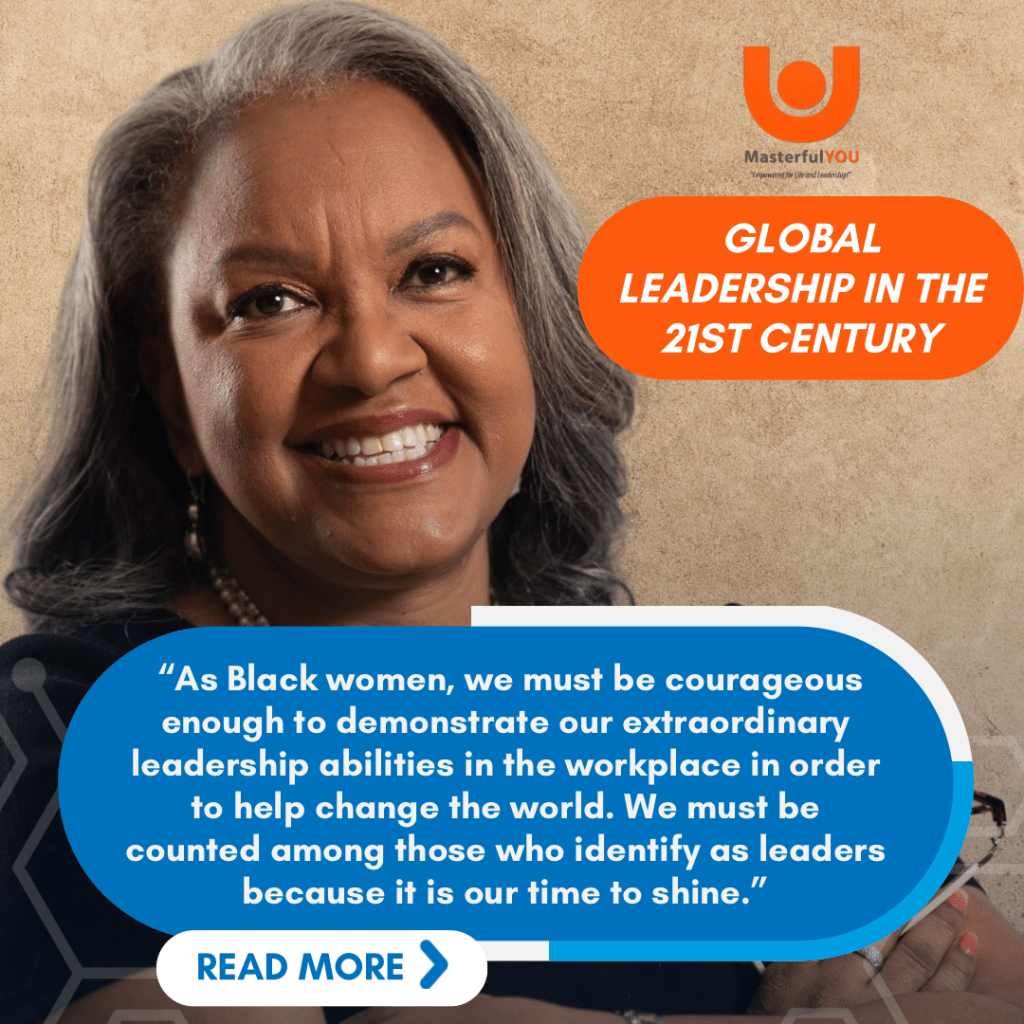
There is a scripture in the Bible about a courageous female leader that says, “And who knows but that you have come to your royal position for such a time as this?” (Esther 4:14 NIV). This verse is a reminder for me that sometimes leadership is a matter of being in the right place at the right time and recognizing that God is calling upon you to act. Being an extraordinary leader requires the opportunity to work in an environment that allows you to thrive and live up to your leadership potential. As leaders in formal positions of authority, we look among the sea of men and women and seek out those who model extraordinary leadership abilities and who have the courage and confidence to prepare the next generation. As Black women, in particular, we must be courageous enough to demonstrate our extraordinary leadership abilities in the workplace in order to help change the world. We must be counted among those who identify as leaders because it is our time to shine.
Originally published as a chapter called “Her Identity as a Leader” in The Professional Woman: Leadership, Courage & Confidence (2020) by Linda Ellis Eastman.
The apostle Paul says, “God comforts us in all our troubles so that we can comfort others” (2 Corinthians 1:4).
So many people are suffering from workplace trauma. As organizations evolve, not all leaders are equipped to manage the people side of change. Unfortunately, I think Black women are having the worse time ever in corporate America. As an HR professional and coach who has been transparent about the challenges I’ve faced, I get calls daily asking for help with different obstacles that Black women are facing. A protege told me recently, that it doesn’t appear that anything bothers me because I’m always so optimistic. However, I’ve suffered personally from work hurt. I have dealt with bias, discrimination, workplace bullying, gaslighting, micro aggressions, being passed over for promotions, unfair assessments, and I could go on and on. I am just grateful that I don’t look like what I’ve been through over the last 30 years.
Although Black women are not alone in suffering from work hurt, I believe there is something to be learned from our experience. This month my family held a reunion of my dad’s siblings and their children, grandchildren and great grandchildren. As we reminisced about our childhoods, I was reminded that resilience is a family trait. My grandfather, who only had a 5th grade education, left a legacy of faith and family as strong values that sustain us to this day. He moved his family to Memphis when my dad was 10 years old after being cheated for the umpteenth time as a sharecropper in Nesbit, MS. What I learned from him was finally put into words by a co-worker when I was trying to deal with abusive behavior by so called leaders. They said “no one can ride your back if you don’t bend over.” That’s when I began to learn how to advocate for myself and to set boundaries to protect my mental, physical and spiritual health.
Healing from workplace trauma takes time and support. I didn’t seek professional counseling at the time (although I needed it), but I did have some good advisors who helped me tremendously. More importantly, I knew that what I believed about myself and my situation would either be enabling or crippling. It wasn’t easy but these beliefs helped me to heal from my work hurt:
1. I am worthy – You need a tremendous amount of self confidence as a black woman in corporate America. We are bombarded with subtle messages every day that make you feel like you don’t fit the ideal. Everything from our hair, clothing, body image, tone of voice, speech, and ways of working is different from the status quo. You have to be comfortable in your own skin and it helps to have role models and mentors who look like you to make you feel ok when most days you’re the only one who looks like you in every meeting. Remembering that you earned your seat, that you are smart and that you have a unique perspective that adds tremendous value is key. You belong!
2. I don’t have to tolerate mistreatment- There is nothing worse than feeling helpless and when you don’t think you have anyone you can go to it’s like being trapped. If a policy is being violated then I think it should be reported and the person held accountable for their behavior. ( Reach out to https://cagedbirdhr.com/services for help.) Unfortunately, when you work in the group that other people are supposed to come to for help, you feel like you don’t have anyone to go to when it’s you that is being harassed by your boss. I found that the best way to deal with a bully was to stand up to them and call them out on their behavior. It may not change the situation but it’s liberating and validating. This is a form of agency that I didn’t learn as a child because showing respect for authority generally meant being quiet. However, everyone deserves to be treated with dignity and respect in the workplace. If you’re hurting me, now I will let you know regardless of your position.
3. I can’t just go through it, I must grow through it – I’ve always been conscious of the fact that others are watching me and that what I do and say reflects on my family, my culture, my affiliations and most of all Christ. During a tough season, one of my friends advised me to “watch my testimony” as a reminder that I was representing Christ in the workplace. I was also reminded that our tests become our testimony. That’s why it is helpful to first try to understand what’s the lesson for me in a situation and then to consider how my experience might help someone else. Adversity builds character and wisdom.
4. If I don’t take care of me, no one will – Practicing self love, self care, and wellness are vital. I had to learn that I couldn’t pour from an empty cup. Making time for the people and activities to feed my soul and fill me up has become very intentional and keeps me from drowning in the demands of the job. This is why boundaries have become crucial. No is a complete sentence but you have to let people know what your boundaries are. That way, it’s a conscious decision when you allow them to be over stepped.
5. Gratitude and anxiety can’t exist in the same space – Whenever I started to worry or become overwhelmed, it helped me to remember how much I had accomplished. It’s hard to stay anxious when you’re focused on being thankful. This doesn’t mean I don’t acknowledge the hurt or that I don’t feel angry about unfair or mistreatment. It’s just that I realize dwelling on those things will make me bitter not better. I can choose not to rehearse the hurt. I can release those things that I can’t control and focus on what’s good. I can smile in the midst of my pain when I’m grateful.
It would be nice if life were fair and all leaders were inclusive servant leaders who demonstrate care and value the contributions of their staff. That is my vision and hope for corporate leaders. In the meantime, I hope that my experience and lessons learned will help someone else heal from the hurt that some in leadership roles inflict.
I worked my way through college and grad school as a Reservations Sales Agent with Delta Airlines so I can truly relate to the flight plan analogy. In those days, I would book what we called long haul or short haul flights for passengers.
As an HR professional with ExxonMobil, I’ve also done a lot of recruiting throughout my career. So, continuing with the flight plan analogy, as a recruiter I was trying to confirm prospective employees for a long haul with ExxonMobil. I’ve been on this flight for over 30 years, and it’s been quite an experience. This trip has taken me places I never even imagined when I first got on board, and we’ve made a couple of stops along the way where I got off. For those of you who have chosen to come along for the ride, there are some things we all need to remember about this career journey that we are on.
First, remember that the captain of this flight is our chairman. There are co-pilots (Senior leadership), flight crew members at all levels of responsibility (supervisors/managers) and passengers with varying degrees of status/experience flying with us. And like most commercial flights, all we have is a general idea of where we are going but we leave flying the plane to someone else.
Before we take off and soar to higher heights, I need to provide you with a safety briefing. We need to lighten our load of any excess baggage. We can only lift off when we feel confident in our own skin, when we are cultivating our own sense of safety by setting personal boundaries, and when we are clear in minds regarding our compelling personal brand. I believe that in order to have a psychologically safe flight and soar as passengers on this journey, we need to remember 4 things:
1. The S in soar stands for our Strengths. We have to know what we bring to the table we can operate from our strengths. For those familiar with core strengths, I’m a red-blue. That means I’m generally quick-to-act, persuasive and inclusive. I also have strong facilitation and communication skills. We all need to know our strengths and how to put our skills to work in a way that shows we are aligned with the direction of the pilot. But more importantly, we need to know what it takes to get from coach to first class and that’s by taking advantage of opportunities that come your way.
2. The O stands for Opportunities. Early in this career journey, you get onboard and there are plenty of open seats. Sometimes you get to choose but often you have opportunities presented to you. I was always ambitious, and to climb the corporate ladder in HR, so I needed to be flexible to get operations, HQ, and manufacturing experience. I also knew that all roads in the oil industry led to Texas so I needed to be mobile. It’s up to each of us how we respond to the options presented and whether we see them as a chance to learn and grow or just another seat change.
3. The A stands for Aspirations. One of the lessons I learned early in my career is that you need to have personal goals and priorities that allow you to evaluate the opportunities that are put in front of you. In my first marriage, my husband and I discussed each opportunity as it came to us. We didn’t have a clear sense of what we wanted as a family to measure those opportunities against. After 13 years with the company, I got an opportunity for a great career move, but my husband decided he didn’t like where the flight I was on was headed. He decided to get off and I stayed on. Things might have turned out differently if we had defined our aspirations up front together. You have to know what you want out of this so that you can make decisions that align with your goals and aspirations. Then you have something to measure your results against.
4. That’s what the R in soar stands for – Results. We each measure success differently and it’s all relative. Relative to where we started. Relative to the opportunities we chose to take or not take advantage of. Relative to what we expected and our aspirations. More often than not the definition of success changes the longer we’ve been on this journey. As our altitude changes, we see the world differently. Remember, we sometimes have to adjust when we hit turbulence and trust the crew keep us on course. That’s all a part of the journey.
I’m really proud of the journey I’ve had, the great people I’ve been able to work with, the places I’ve been, and the things I’ve accomplished. I had high aspirations when I got on board, and I’ve had many opportunities to learn and grow. As passengers, we have different itineraries with different destinations but remember to buckle up and listen to instructions from your flight crew. We are ready to SOAR!
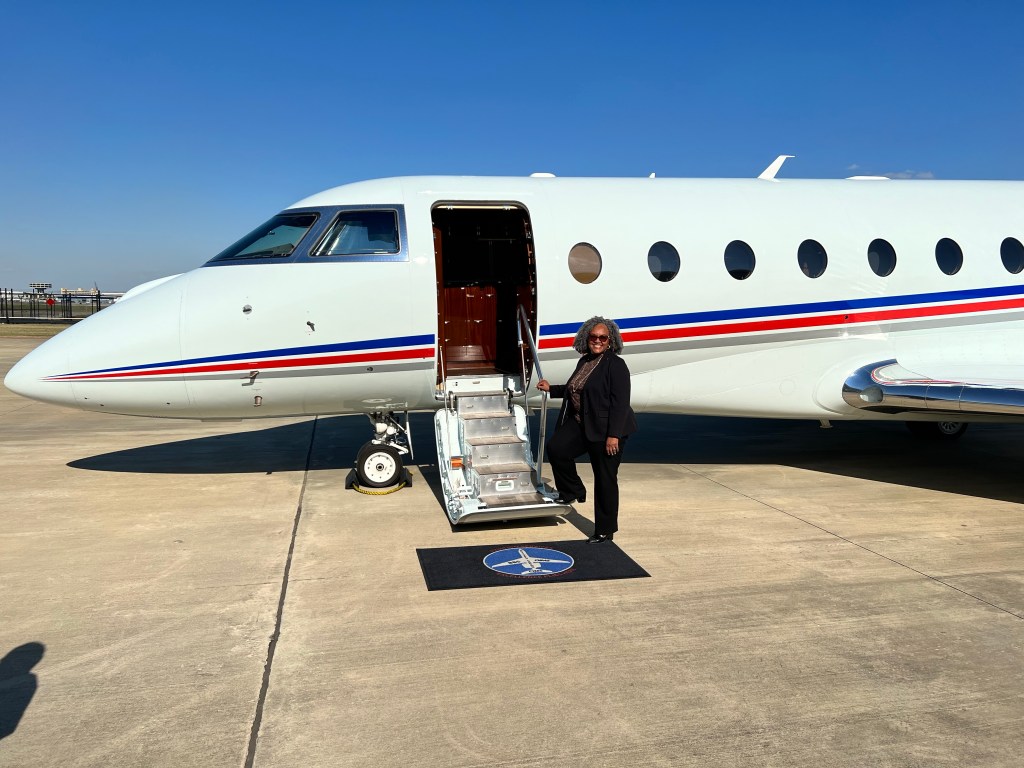
This is a picture of me realizing a dream after 30 years with the company, which was to fly on the corporate plane. I’m truly soaring!
For every high potential, high performing individual climbing the career ladder, there are literally hundreds (dare I say thousands) that are stuck half way up. According to research by McKinsey and LinkedIn.org on Women in the Workplace, only 86 women for every 100 men get promoted to manager. Unfortunately, many of the rungs are broken for women and minorities. The reality is that there are many obstacles to success regardless of gender and race. We all know that its a pyramid and that the number of jobs at the top are limited but we were sold a dream. In fact, one of my biggest issues with our system is that we frustrate and disenfranchise 80% of our population each year by telling them that they are no longer the outstanding person that they have been told they were all their lives. This isn’t a new phenomena, but I think its time we all looked at it differently. It’s time to update the script on how we define success.
Like most of my colleagues, I was hired based on having been a high achiever all my life. Having successfully navigated college and grad school, I came to Exxon 30 years ago with high aspirations. I did all the things I’d been taught in my MBA program about successfully managing my career. There wasn’t a networking event I didn’t attend. I had mentors and sponsors. I focused on delivering high quality as well as a high quantity of work. I studied what our expectations were to be considered “better than most” and demonstrated the behaviors that were valued by my supervisors and managers. I knew everyone on the staffing and development committee making decisions about future assignments and they knew me. I gave generously to the United Way and celebrated every milestone event with my colleagues. The world was my oyster until one day I realized that I was stuck halfway up that ladder. With all that effort, it seemed that there wasn’t going to be another promotion in sight. I had hit a ceiling.
The point of this article is not to feel sorry for me, but for me to share how I learned to thrive despite my disappointment. The reasons why I didn’t make it while others did are not as important as how I responded to not having achieved what I knew was my potential. I believe there are seven things that can help us learn to fail successfully:
1. Remember that your performance assessment is not your identity. In a recent blog, Becoming a Mental Well-Being Champion, I mentioned having been assessed in every category except ‘needs improvement’. However, the most challenging feedback to receive was that I dropped out of the top performance category. It took years to reconcile that message with what I believed about my own performance and capabilities. There was a song by India Arie called “I Am Not My Hair” which I translated to “I am not my RG” at the time that really helped me to disassociate my identity from performance labels. I had to tell myself that I didn’t change, my level of contribution and commitment didn’t change nor did my IQ.
2. Broaden your comparator group for perspective. I have been able to maintain an extensive professional network externally which really allows me to recognize the quality of the workforce that we have within ExxonMobil. I’ve always been proud and fascinated by the intellectual and technical excellence that I rub shoulders with on a daily basis at work. While I have a lot of equally smart associations, it has not been lost on me that we have hired the some of the best and brightest around the world. My external network keeps me informed of how my peers are doing in other organizations and that often the grass is just as yellow elsewhere.
3. Admit that staying is a choice. Committing to a long-term career is like being in a marriage. It’s no surprise that some days you will question why you’re still here. At some point we all wonder whether we should stay or go. However, reflecting on why you joined and why you stayed is healthy. It reminds you that you are making a conscious choice to stay for whatever reasons that may be. That is empowering because no one wants to be a corporate slave. I acknowledged that the worse that could happen was that I might lose my job as the sole provider for my family. However, when I realized that even if that happened, we would have a place to go and I had marketable skills, that concern was no longer a threat to my peace.
4. Market your skills and abilities. I’ve done countless employee sessions on knowing what you bring to the table and establishing your personal brand. Most assignments later in your career come because someone knows what you can do and preparation meets opportunity. You can tell very little about someone’s background and experience based on their job title, so its important to let people know what you can do. Update your online profile. Develop a short bio. Put a more descriptive title in your signature. Develop an elevator speech so that you’re ready when someone asks “what are you working on these days?” You have to be your own salesperson at all times. Don’t leave that to your supervisor.
5. Redefine success based on your values and passion. At the end of the day, only you know what’s important to you and your family. Think about what brings you joy and/or satisfaction. What excites you about your chosen profession? There are always aspects of a job that are less exciting than others. However, you can lean into those aspects of your job that align with your passion and look at the rest of your to-dos as the cost of entry. As a recovering workaholic, I started to define success as having balance in my life so that I could enjoy the last years that my kids were home (e.g., eating dinner together, dropping them off at school, taking family trips). I realized that being “stuck” actually freed me from pressure at work that would have not allow me that precious time.
6. Set SMART goals that help you measure your progress. I’m still a type A personality that thrives on personal accomplishment, so setting personal goals helps to keep me engaged. We now have talent management processes in place for work goals and development goals, so its important to make those work for you. I know that I am deadline and goal driven, so having SMART goals works for me. It actually works for everyone (I’m just saying).
7. Celebrate your wins. You don’t have to wait for others to celebrate or appreciate you. Sometimes we have to encourage ourselves. Invite your boss to your celebration when you’ve accomplished a personal or professional goal. If not your boss, at least someone who has been part of your success. This is how we build community.
I may not be where I thought I would be at this point or even where I had the potential to succeed. Yet, I look back over my 32 years and I’m extremely proud of my career. I’ve helped a lot of organizations to achieve their business objectives and collaborated with wonderful people around the world to get things done. It may have seemed like I was stuck, but the view looks good from here. What are the possibilities for you with a different definition of success?
Okay, I can’t remember the last time I picked up a drill or a reciprocating saw, because like most of my colleagues, I spend most of my time at a computer. The flipside is that at work, I have been amazed by Microsoft’s Power BI functionality with managing metadata. It’s a power tool for geeks that turn’s information overload into useful insights. This got me to thinking about another power tool that is built into all of us. Our emotions. Before you tune me out, let me explain how emotional intelligence can help us live out our values of resilience, care, integrity, courage and even excellence. I’m not encouraging us to allow our emotions to take center stage, but I do want us to see our emotions as data. When we do this, they can become our power tools for reengagement, creativity, and enjoyment at work.
Emotional intelligence relates to self-perception, self-expression, interpersonal skills, decision making, and stress management. Research has linked these competencies to effective leadership because emotions are what makes us human. However, in business we are generally expected leave our emotions at the door. We see being emotive as bad, but the truth is that we still have feelings whether we acknowledge them or not. When we suppress them, they only become stronger, and we lose the ability to deal with a situation as it really is. When we pay attention to our emotions, they can provide data on what’s important to us and help us to understand ourselves and others. More importantly they can help us define actions connected to our values to respond to what’s creating the emotions.
How do we put our emotions to work? Our thoughts drive our emotions and subsequently our actions. When we sit with our emotions and label them correctly, we can figure out what is making us feel that way. Instead of just saying “I’m stressed,” consider if you’re disappointed, dreading something, or overwhelmed. Doing the analysis to understand the emotion is the first step to decisive action. A critical element of human performance is learning to manage our thoughts. As humans we must rely on both “fast” thinking, which is helpful in everyday decisions to leverage our experience and “slow” thinking, which is more controlled, curious, and strategic to deal with more complex situations. We must resist the natural flight, fight, or freeze response to negative emotions and find the courage to examine our thinking. One of my favorite sayings is change your thinking, change your life (Brian Tracy).
In my own career, there was a time when I was feeling powerless and not able to change a negative relationship with my manager. My first instincts were to flee from the situation as fast as I could. However, I really liked my job and I felt like I was making a positive impact on the organization. When I shifted my thinking from “I need this job, so I have to accept being miserable” to “I have options, but I choose to be here because I like my job,” there was an immediate change in my relationship with my manager. I had the courage to address the behaviors and work challenges that were making us both less effective as leaders. Furthermore, as a leader, I learned to pay more attention to my colleagues and to push through awkward emotional interactions to better understand the situation at hand. I learned to listen more and to notice emotional cues. For example, if I asked, “How are you?” I waited for a response and looked to see if it was consistent with the body language I was seeing.
Emotions are not good or bad. They are tools that can be used by anyone who wants to influence human behavior. Accepting that we are emotional beings is the foundation for resilience. It improves your perception of yourself and your ability to express yourself which enables personal integrity and excellence. Good interpersonal skills are necessary for demonstrating care and concern for the well-being of others. Finally, building these emotional intelligence competencies takes the courage to act with conviction based on data. Emotions make us powerful. If you still have doubts, call me.
Today is World Mental Health Day and I’m here for it! I’m working on becoming a mental wellbeing champion because I can relate to dealing with work hurt during my career and still finding purpose in the everyday. Learning that another colleague had just resigned made me sad because I had seen their struggle. It also made me determined to do more. There is a lot of research on well-being and the power of positive psychology, however, my desire is to be a champion by being more vulnerable. So, I’ll start with sharing how I manage my own mental well-being.
First, the need for a sense of belonging is real and human. I satisfy this need by creating community at work. Whether it’s my work team or my BEST friends, or the extended network across the corporation developed over my 32 years with the company, I try to be intentional about getting to know people and letting them know me as a person. Not everyone that I’ve worked with has become a friend, but I can truly say that I’ve found a true friend with each assignment that I’ve had. We spend a lot of time at work and all you really need is just one person to make your work life fun.
Second, having a sense of purpose gives me perspective. I truly believe that that God has put me in each assignment and that the job is secondary to His purpose for me. Leadership is a high calling and I believe that you can lead from any seat at the table with authenticity and empathy. This perspective helps me to look at my work differently and to remember that nothing that happens to me is by chance. I look for the opportunity to serve through my daily work and that keeps me grounded.
Finally, I remember that things will generally work out in the end for my benefit without me worrying. Every time I’ve had a setback or difficult situation, I’ve learned from it and grown in ways that I couldn’t have imagined. I’ve been labeled “high potential” and I’ve been considered someone who “needs improvement” but I didn’t allow either of those perceptions of me to define me. My IQ didn’t change based on my performance assessment, neither did my work ethic or sense of personal accountability for doing my job. My self-worth is based on knowing who I am, my values, and my connection to a higher power.
Yesterday, I had the pleasure of attending an award ceremony to celebrate with our two ExxonMobil finalists for the Ally Energy’s Annual Grit Awards. Ally defines GRIT as growth, resilience, innovation, and talent. Each of these is necessary for mental well-being. However, Angela Duckworth in her book, GRIT: The Power of Passion and Perseverance, says that grit is the ability to persevere in the face of setbacks and disappointments, and to strive to improve even amid success. One of the most powerful insights in the book is that grit can be learned, regardless of IQ or circumstances and that any effort you make ultimately counts twice towards achieving your goal. If your goal is to have a fulfilling career that allows you to work with amazing people and do some very interesting and valuable work, that can be done. It just takes grit!
Every where I turn, people are stressed out at work. Unfortunately, the underlying cause is often that they don’t feel valued or don’t feel like leaders are concerned about their wellbeing. What’s interesting is that caring leadership has been linked to increased organizational commitment, heightened workplace self-esteem, and improved organizational performance. It struck me, however, that having care as a core value is only impactful if leaders understand what care looks like in action. I was reminded of something I learned studying Gary Chapman’s The Five Love Languages. That is people feel loved in different ways and they tend to express love based on their own love language. We should learn to show love based on the recipient’s love language. Doing unto others as you would have them do unto you doesn’t actually work. It takes a bit more effort to understand what care looks like to someone else but here are 5 tips for demonstrating the language of care:
1. Mutual respect – Empowered employees feel like they have more control over their work lives. The days of ‘father knows best’ in a patriarchal company culture are over. Employees want to and should be treated as mature adults. This means engaging them in decisions that affect their future and providing them with the resources that allow them to be effective. However, in the words of Aretha, you should find out what respect means to the individual.
2. Meaningful work – Challenging and meaningful work gives purpose and a reason for getting out of bed in the morning. Ideally, each assignment should include an opportunity to demonstrate skills and knowledge as well as to learn and grow. Studies have shown that some people prioritize meaning over happiness. The leader who cares wants employees to feel like they are doing something to further the mission of the organization. Helping people have a line of sight between their work and the company mission is an act of caring.
3. Compassionate feedback- words of appreciation don’t have to be in conflict with constructive feedback. Recognizing that someone is working hard demonstrates care for their effort. Difficult feedback conversations are necessary for learning and development but helpful constructive feedback is rare. By being clear that your intentions are to help them grow as a professional, the feedback is more easily received and you show that you care with words of affirmation for their efforts. Some employees thrive on verbal expressions of appreciation.
4. Flexible time – Making time for family, friends, and fun can be difficult when the pressure is on at work. Recognizing signs of burnout and fatigue is a way to show care and concern for an employee’s well being. Flexible work policies allow leaders to provide time off or allow people to work from home as needed to balance work and life. For some employees the gift of time is the best way to show you care.
5. Rewards & Recognition – Salary increases are always good and knowing that you’re paid competitively is important to almost everyone. However, expressing appreciation throughout the year for meeting goals and reaching milestones is also a way to demonstrate care. Thoughtful gifts and gestures mean a lot to people who need tangible tokens of thoughtfulness.
At the end of the day, people don’t care about what you know unless they also know that you care. Let’s lead with care by getting to know our people and demonstrating it based on what they value.
By the way, what’s your care language? Mine is flexible time!
I recently wrote that I needed more than ally in order to feel included and valued as an employee in the workplace. It wasn’t that being an ally was bad, it’s just because it falls short of the need to make my struggle your struggle. The only way that significant sustained progress will happen is for the objectives of inclusion and diversity to be personal. We mostly care about things that matter personally.
The ability to demonstrate empathy is a core competency of emotional intelligence. Fortunately, empathy is a skill that can be learned. Caring builds the empathy muscle and it’s a value that needs to be practiced every day to really master it. In a course called “Living Undivided,” I learned that when you really care you will:
C– choose to allow someone else’s experience into your heart,
A– Acknowledge that their feelings are valid,
R– Recognize the emotion in their experience, and
E– engage and lean in to seek a deeper understanding.
In a meeting to discuss how to build capability within our talent pools, a manager (who I will call Steve) asked why he never heard about any employees from a certain country when discussing executive development. He always heard about the great talent in that country and how much they were contributing but none had been identified with executive potential to date. Just his question started a flurry of activity. Contacts were made within minutes to ensure there were meetings to discuss their potential and development needs. Suggestions were recommended to make sure that there were no arbitrary limits put on their potential (and there were) and steps were taken to make sure a review was planned as soon as possible of the top talent in that country. More leaders should be like Steve. He is more that just an ally.
One Employee Resource Group (ERG), has a senior manager who went to bat to make sure they didn’t lose traction in their mentoring program while waiting on the corporate program. They tested to see where there would still be gaps and aligned their program to make sure that everyone in the organization got the additional feedback and support provided by mentors for their development. Recognizing that their voice carried weight, they leaned in to make sure members of the organization didn’t fall through the cracks because mentoring has been proven to help minorities and women succeed.
At an individual level, caring is staying after work to discuss strategies for balancing work demands with the challenges of being a single parent. It can also be inviting someone on your team who doesn’t look like you to your home or visiting them at their home to get to know them and their family. It can be giving the gift of feedback to someone you know is struggling to understand why they aren’t doing as well as their peers when they are working twice as hard but you know it’s behavioral.
I certainly don’t have all the answers but I do know that people don’t care what you know until they know that you care. Let’s stop trying to be validated and start being the type of humans others want to be around at work — people who care.
I think it is awesome that there are many allies within Black employee networks and other minority employee resource groups within corporations. It’s a proactive way to show support and make a statement regarding the importance of inclusion and diversity. However, in my humble opinion, this falls short of what is really needed to move the needle with respect to equitable representation at all levels and creating a culture that embraces the unique strengths of our employees regardless of their race, ethnicity, religion, sexual orientation, or gender. What we really need are leaders and employees who form an alliance to achieve the aspirational culture defined by the company’s I&D mission statement. An alliance recognizes the combined strength of its partners to advance both the collective and individuals.
As business-minded individuals, we all understand the need to move from continuous improvement and incremental innovation to strategic and step-change innovative actions to win in an increasingly competitive global economy. Yet, the same is true of our I&D efforts. The time has come for us to do more than meet the minimum requirements. It’s time to put action to our well-crafted words of support for inclusion and diversity. Not because you want to meet a target. Not because it’s the right thing to do. Because creating an inclusive environment for a globally diverse workplace is a competitive advantage. Leveraging all the talent within your company is the only way to get a great return on the investment made in recruiting them. However, it is only when I&D is personal that we can bring about sustainable changes.
Let me explain. When I joined the workforce thirty years ago, there were very few women and those who were here then spent a lot of time focusing on assimilation (e.g. trying to fit into a very male-shaped mold). However, I noticed a significant shift when the wives and daughters of our executives started complaining about the challenges they were facing in the workplace. All of a sudden, work-life balance, childcare, and flexible work became important to the men in power. Because it became personal. When someone you know and care about is struggling, you want to do everything in your power to help them out. These weren’t uncaring men. It just took a while for women’s issues to become their issues.
In a recent conversation with a diverse group on racial equality, I was curious as to why a group of late-career or retired white men and women cared about the topic. Once I learned that they were either an immigrant to the U.S., in a biracial relationship, or had biracial grandchildren, it all clicked. Before that, other races were just that, other. When something doesn’t concern you, it doesn’t mean you don’t care. It’s just not something you think about on a day-to-day basis. I understand that. However, our success as a species depends heavily on our ability to care about the entire human race. This is what the generation entering the workplace today sees more clearly than the baby boomers who made little progress in this space since shortly after the civil rights movement. I’m with them. I care about more than just my family, my community, and those who I know personally.
Martin Luther King, Jr. once said “We must learn to live together as brothers or perish together as fools.” Likewise, we must learn to work together, look out for each other, and champion one another for us to create true inclusion. Allies should not be my competition because we are on the same team. Because we care, our mission should be to do all that we can to break down silos in the workplace and help the next generation to succeed where we could not. As an alliance, we can work together to tap into the strengths and capabilities of all the amazing people that we hire and channel their collective energy into building better companies, better work environments, and a better world. When we leverage the capabilities of the entire diverse workforce and make everyone feel valued, we all win.







 Masterful You