Tomorrow’s followers will require a new type of leadership. The world is changing fast, and the workplace is adapting out of necessity. Business environments are multicultural, and people are transient across international borders more than ever. Issues of worker migration, global trade, cybersecurity, new technology, and, yes, even identity issues require leaders who not only value diversity but can leverage it for better results. I learned the concept of “identity” from idealistic millennials, for whom being authentic is a core value. They want the freedom to bring their whole selves to work and do not feel the need to assimilate. Recognizing the new mindset, Corporations are changing to attract this ambitious, talented, and worldlier generation. This new generation of workers has access to more information at their fingertips and a better appreciation for global issues than previous generations, yet they still need role models. They must be nurtured and inspired. They must be challenged and given boundaries. They need leaders with the courage and confidence to solve problems we have not yet conceived.
A rose is a rose, but not all leaders are made equally. Those who identify as leaders may share similar characteristics, but they are not all the same. Certainly, some aspects of leadership are innate. Some people have a natural ability to inspire multitudes to act or believe a certain way. Some leadership behaviors can be taught, such as how to plan, how to manage a project, and how to communicate a way forward that motivates others to act. In fact, the topic of leadership and what it means has been extensively studied. However, there is no singular definition or even theory that researchers agree on. Some leaders are visionaries who help others see a better tomorrow with clarity and color. Some are excellent strategists who know how to develop a plan of action and pull the resources together for people to get it done. Others know how to inspire and motivate people to achieve a vision even if it is not their own. Leaders do not do things alone; they work to ensure that objectives are achieved effectively, efficiently, and without harm to stakeholders to achieve a better future. I believe that leadership is what you do and who you are rather than your title, so I have embraced the label of a leader as describing someone who influences others by words or deeds to act or think differently.
As another generation of young professionals join corporations with ambitions to make their mark, it is important that we re-evaluate the type of leadership required for the 21st century. These new followers need a new type of leader to inspire trust, creativity, and motivation. These leaders must have what Daniel Goldman calls emotional intelligence, which includes astute self-awareness, self-regulation and motivation, empathy, and social skills or relationship management. Self-awareness is critical to recognizing conscious and unconscious bias, which is all too common among individuals who have little exposure to different cultures. Self-regulation and motivation allow leaders to build credibility and demonstrate clarity on required outcomes. The ability to manage emotions comes with maturity and experience in dealing with challenging people and situations. Finally, trust is the foundation for developing productive relationships that can empower others and unleash creativity.
Today’s youth are motivated to excel by leaders that they believe care about them as people. They are not easily impressed by gray hair and war stories. This doesn’t mean that young people don’t value wisdom, knowledge, and experience, but they want leaders who inspire them. They will not care what you know until they know that you care about them as humans. Women, particularly mothers, understand how to handle people with care and consideration of their individual needs and motivations. We have learned, through parenting, how to value differences in our children. This helps us to be more empathetic, appreciate diversity, and value each individual’s contribution. We lead from the heart as well as the head.
Large multinational companies are having to change the way they do business in the face of a more transient, tech-savvy workforce and increased competition for global talent. Just a decade ago, companies were moving work across the globe to lower personnel costs, but now the talent is moving across borders to find higher-paying jobs. It is increasingly hard to find a company with a homogeneous workforce, so learning to lead a multicultural team is a critical competency required for future leaders. There are significant efforts to improve the skills and abilities of today’s corporate leaders in the face of this changing environment. However, what is forgotten or minimized is the impact of cultural differences and the skill levels of workers on the leader’s ability to influence productivity. Leaders must be able to recognize that different cultures are motivated by different factors. Maslow’s hierarchy of needs is a place to start for insight into what drives behavior, but it is easy to simply focus on developing authentic relationships. This means getting to know people, individuals that you need to influence, and what is important to them.
I believe that leadership is a calling and a gift, but it can be wasted without opportunity and nurturing. Like other natural abilities such as intelligence, self-confidence, determination, integrity, and social skills, leadership skills are honed over time and heavily influenced by nature and nurture. As leaders, we are the sum of our experiences and the teachings of others. Natural leadership abilities, when combined with good management skills, can make anyone an extraordinary leader in business, given the right opportunities. It simply takes confidence to take on leadership roles and to get out of our comfort zones to stretch ourselves. We must not only take advantage of opportunities to learn and grow with challenging assignments, but we must also seek them out. Our productivity is enhanced as we focus on our strengths, delegate activities in our weak areas, and continue to develop as leaders with each new experience. Without the opportunity to shine, a person with natural leadership ability will just be an interesting person to know.
Women and Minorities Lead Differently
I believe that unrealized potential is a waste of God-given talent. Unfortunately, women and minorities continue to face barriers to reaching senior positions within corporations. Despite decades of focused development for both women and minorities with some visible success, there are still gender and cultural biases, prejudice, and other barriers that affect progress. Dealing with gender bias, ethnocentrism, prejudice, and cultural bias is something that affects aspiring leaders at every level in an organization. In Cracking the Corporate Code: The Revealing Success Stories of 32 African-American Executives, the authors note the reality that minorities and women leaders tend to have a slower career progression initially, with more testing and requirements to prove that they have leadership potential than others. This has the effect of them having significant functional expertise when and if they achieve a position in the C-suite. Because they often do not get to senior corporate positions, these limitations are igniting a surge in entrepreneurship among women and minorities in the U.S. Business ownership puts them more in control over their own destiny and creates their own leadership development opportunities.
By capitalizing on what makes them unique, female and minority leaders are in a great position to inspire others to embrace their differences and increase engagement in the workplace. In the past, successful leaders have been associated with stereotypical masculine attributes such as competitiveness, task orientation, and willingness to take risks, but a trend exists where women are now succeeding with distinctly feminine styles and attitudes. Supportive and facilitative leadership styles combine many feminine concepts and focus heavily on emotional intelligence, which bodes well for more gender equity in leadership positions. Similarly, “minorities” in Western corporations have a unique experience navigating between different cultures that should be tapped into for leading multicultural teams. These two aspects provide insight into potential new models for successful global leadership that is both diverse and inclusive.
This author has experience working for two companies with successful strategic partnerships between the East and West. Their shared values of safety, excellence, collaboration, respect, responsibility, and integrity allow them to leverage the strengths of both organizations to achieve business objectives. Rather than focusing on cultural differences, they have forged a productive relationship based on shared beliefs. This is a great example of cultural agility and collaboration on the part of leaders in large multinational organizations. It is also a model for how individuals can be better leaders in the future. By identifying and building on shared values, leaders can build relationships and model collaboration within diverse teams.
My Personal Leadership Philosophy
Since my first day at work as an HR professional, I have been blessed to work with people from across the globe. I’ve lived in five states within the U.S. and traveled to over 30 countries. This is amazing for someone like me who grew up in Memphis, Tennessee, which was not very diverse or corporate. (Note: This has since changed with major employers like Federal Express, International Paper, and AutoZone headquartered there). I overcame cultural challenges and assumptions by:
- Leaning into different sources of my personal power, such as expertise, access, and influence, when I didn’t have formal leadership positions;
- Developing networks to navigate internal politics, avoid social isolation, and get things done;
- Conveying passion and loyalty for the enterprise and its mission over individuals;
- Leveraging my female instincts and wisdom to practice subordination and reciprocation to get what I want;
- Leveraging my instincts as a minority to take personal risks, outwit difficult people, and recover from failure.
Currently, I have the great fortune of working as an expatriate in Qatar, a country where virtually every country is represented and every workgroup is a multinational team. In this multicultural environment, professionalism and productivity are valued more than anything else. Despite the fact that there are not many women in senior leadership positions, my knowledge, experience, and ability to help drive strategic initiatives are valued and rewarded. My identity in this environment was as a leader first and secondly as an American. I am not constantly worrying that I am being treated differently because I’m an African-American or because I am a woman. This one difference provided the freedom to be my authentic self as a leader more than I ever felt was possible working in the U.S. It has given me the confidence and courage to shine even more brightly as a leader. Unfortunately, most corporations around the world still have a long way to go in terms of embracing the true value of a diverse workforce and creating an inclusive workplace where gender and cultural biases are not present.
Whether you recognized yourself as a leader first or embraced the label after being thrust into a leadership role, it can be daunting to know that people are relying on you for direction and guidance. That’s why it’s important to step back periodically to reflect on who you want to be as a leader; that is, what makes you a leader. At some point, a leader, whether male or female, must operate from a sense of purpose and have a keen awareness of their capabilities, strengths, and weaknesses. Then, you will be noticed for being the right person, at the right place, and at the right time in history to lead others toward a goal that is bigger than you are.
More than anything else, I believe the characteristic needed for future leaders is authenticity. Technology and globalization have made the world much smaller and more transparent. In this age of information, you cannot hide who you are, so you may as well embrace it. As a leader, I have prided myself on being a person who models her values, which include excellence, accountability, service, collaboration, integrity, respect, and pragmatism. Values-based leadership allows you to relate to people on a much deeper level, no matter what their cultural background. Connecting my vision and my priorities to my values helps me to find opportunities for common ground.
After significant reflection on the subject, I have concluded that leadership comes from an internal drive to use one’s personal power to improve any situation. Focusing on the kind of leader you want to be, seeking a higher purpose for your life as a leader, and recognizing that leadership comes with tremendous responsibility for the welfare of others is what drives my leadership philosophy of purpose-driven authenticity. My philosophy is based on the beliefs that:
- All people have dignity and worth;
- Honesty and integrity are foundational to good character and good business;
- Leadership involves taking action and serving others;
- Love and respect are powerful motivators;
- People don’t care what you know until they know that you care;
- Individual differences make the world richer and help to solve problems more creatively;
- Bias against women and minorities still exists in organizations, so it’s up to those who have influence to remove barriers and speak up for those who can’t;
- Vulnerability is a sign of strength and builds trust;
- People respect leaders who are imperfect;
- Not everyone wants to lead, but we all need leaders.
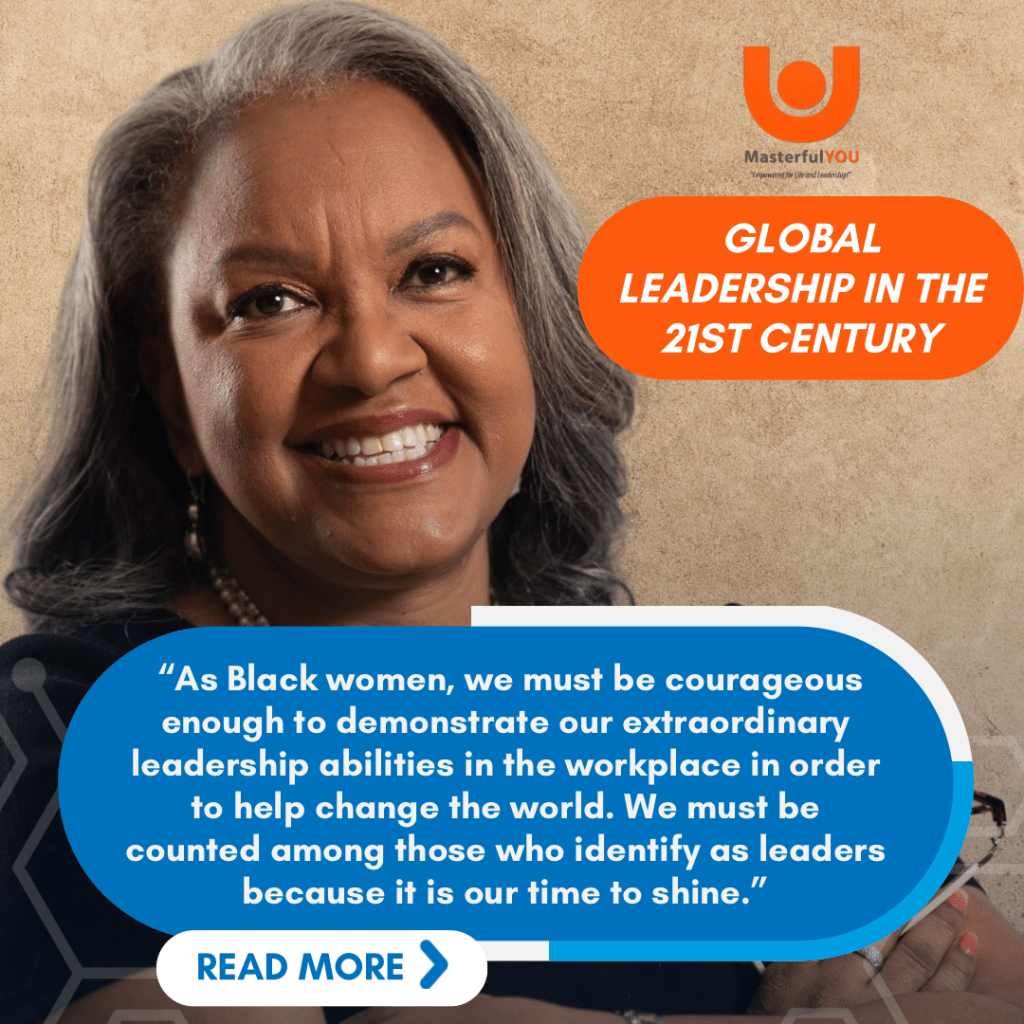
There is a scripture in the Bible about a courageous female leader that says, “And who knows but that you have come to your royal position for such a time as this?” (Esther 4:14 NIV). This verse is a reminder for me that sometimes leadership is a matter of being in the right place at the right time and recognizing that God is calling upon you to act. Being an extraordinary leader requires the opportunity to work in an environment that allows you to thrive and live up to your leadership potential. As leaders in formal positions of authority, we look among the sea of men and women and seek out those who model extraordinary leadership abilities and who have the courage and confidence to prepare the next generation. As Black women, in particular, we must be courageous enough to demonstrate our extraordinary leadership abilities in the workplace in order to help change the world. We must be counted among those who identify as leaders because it is our time to shine.
Originally published as a chapter called “Her Identity as a Leader” in The Professional Woman: Leadership, Courage & Confidence (2020) by Linda Ellis Eastman.
 Masterful You